A Real-World Criminal Case Study and the Future of Forensic Review
Introduction
The volume of digital evidence presented in modern criminal proceedings has increased dramatically over the last decade. Security cameras, mobile phones, body-worn cameras, social media content, and digital surveillance systems generate vast amounts of information that investigators, attorneys, and courts must analyze. While digital evidence has become a cornerstone of modern litigation, the challenge remains unchanged: extracting reliable information from imperfect data.
Many criminal investigations rely on low-resolution CCTV footage, compressed video files, poor lighting conditions, motion blur, partial occlusions, and degraded recordings. In such circumstances, forensic conclusions often depend on the ability to identify visual characteristics that may not be immediately observable through conventional review methods.
Recent developments in artificial intelligence have created new opportunities for forensic practitioners. AI-powered enhancement systems can assist experts in recovering observable information, isolating regions of interest, reducing visual artifacts, improving clarity, and facilitating systematic comparison between evidentiary sources.
Predictive Equations was developed to address precisely this challenge: providing investigators, legal professionals, and forensic experts with advanced AI-assisted tools for digital evidence enhancement and analysis while preserving the integrity of the underlying evidence.
This article examines the role of AI-assisted forensic review through a real-world criminal case involving a series of robberies, illustrating both the capabilities and limitations of emerging technologies in legal proceedings.
The Challenge of Digital Evidence
Digital evidence is often treated as objective. In reality, however, every image and video file is affected by technical limitations.
A surveillance camera may capture an event from a significant distance. Compression algorithms may discard image information to reduce storage requirements. Environmental conditions such as poor lighting, weather, or camera positioning may further degrade visibility.
When investigators attempt to identify a suspect based on clothing, footwear, body posture, or movement patterns, these technical limitations can significantly influence interpretation.
Traditional enhancement methods typically rely on mathematical interpolation, zooming, sharpening filters, or manual image manipulation. While useful, these techniques often reach their limits when evidence quality is particularly poor.
Artificial intelligence introduces a different approach.
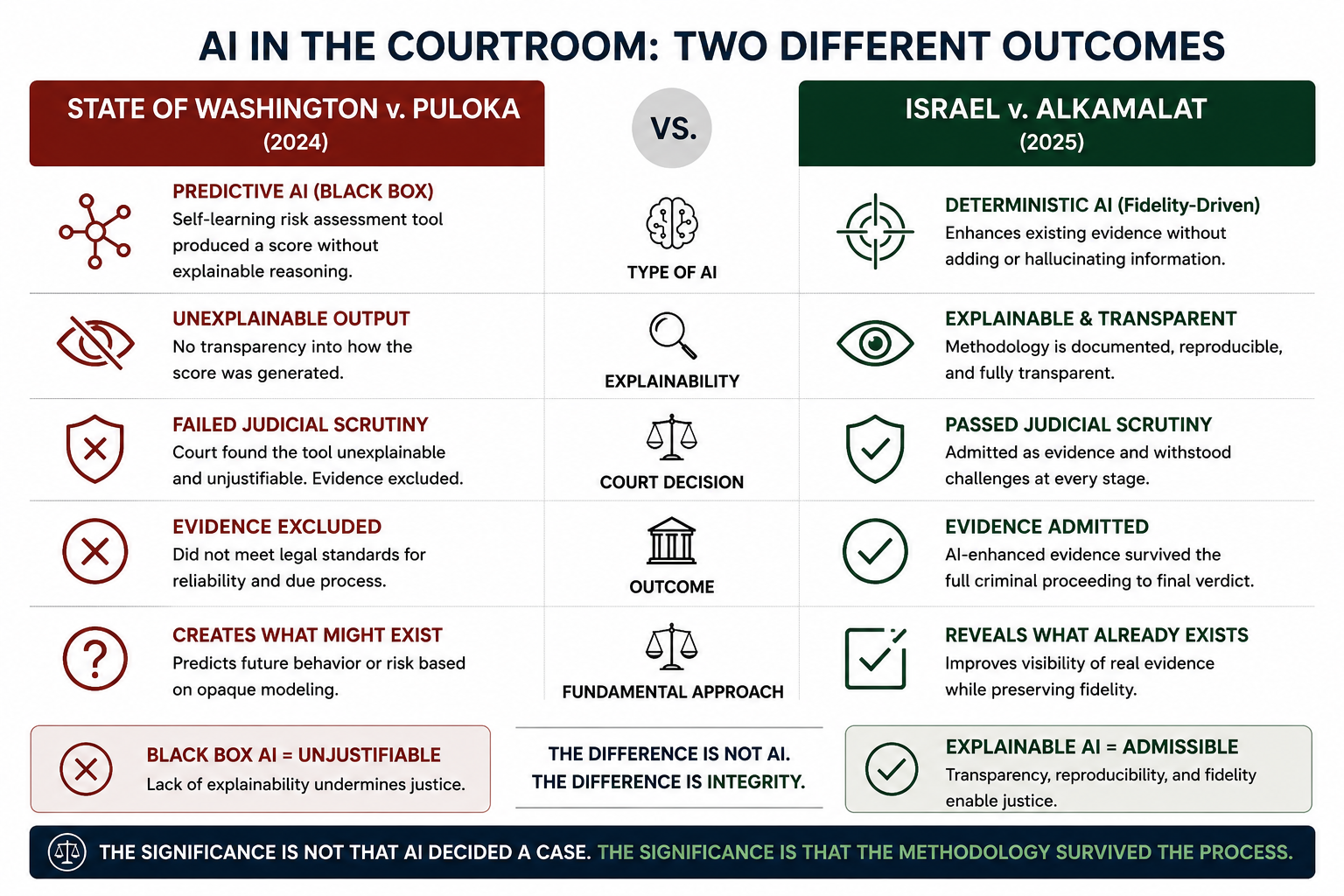
Instead of applying identical transformations to every pixel, AI models can analyze contextual relationships within an image and identify patterns associated with blur, compression artifacts, noise, and resolution loss. Properly designed systems can improve the visibility of existing information while maintaining evidentiary integrity.
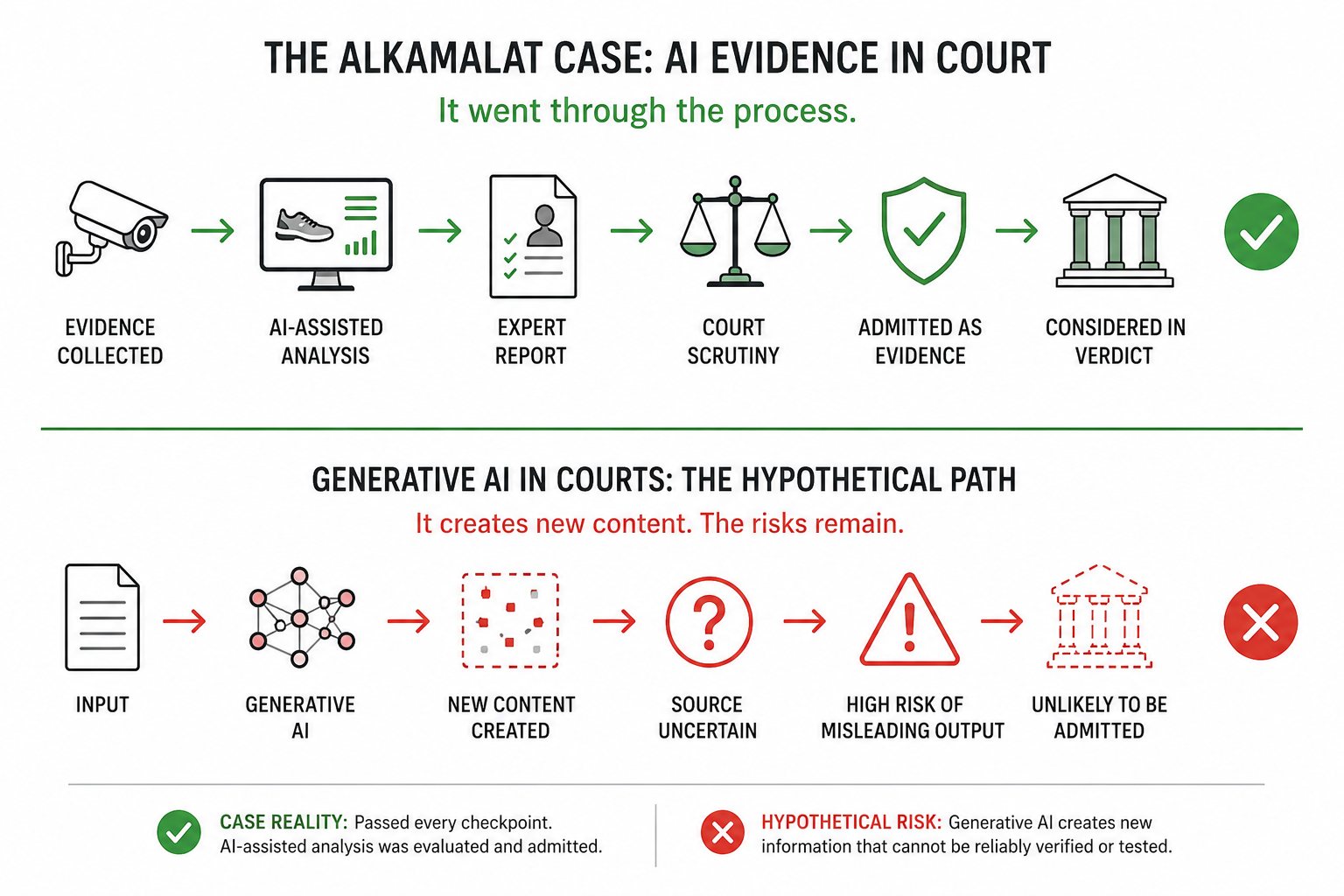
The objective is not to create new evidence.
The objective is to reveal information already present within the source material but obscured by technical degradation.
The Predictive Equations Approach
Predictive Equations utilizes multiple AI-based enhancement and analysis modules designed specifically for digital evidence workflows.
These modules include:
- Resolution enhancement.
- Motion blur reduction.
- Noise removal.
- Compression artifact mitigation.
- Region-of-interest isolation.
- Object identification and comparison.
- Visual feature extraction.
- Comparative evidence review.
The workflow begins by identifying the relevant portions of a video or image. Rather than processing entire recordings, investigators isolate specific regions of interest (ROI) that contain potentially relevant evidence.
This approach improves efficiency while focusing computational resources on areas most likely to contain probative information.
Once isolated, AI enhancement models are applied to improve visual clarity. The resulting outputs enable more detailed observation and comparison of specific features such as:
- Footwear characteristics.
- Clothing patterns.
- Logos and labels.
- Color segmentation.
- Structural contours.
- Wear patterns.
- Distinctive identifying marks.
The enhanced outputs do not replace expert analysis. Instead, they provide a more informative basis from which experts can conduct comparisons and formulate opinions.
Case Study: Analysis of a Multi-Robbery Investigation
In a criminal case involving five robberies occurring within a two-month period, defense counsel requested a digital forensic review of surveillance footage and related evidence.
The assignment focused primarily on the comparison of footwear visible in CCTV footage with footwear associated with an accused individual.
The analysis involved several objectives:
- Examination of video metadata.
- Enhancement of surveillance footage.
- Comparison between the robber’s footwear and the accused individual’s footwear.
- Comparison between the robber’s footwear and an unidentified third party observed shortly before one of the robberies.
- Review of footage relating to the alleged use of gloves during certain incidents.
Using the Predictive Equations workflow, relevant frames were isolated and enhanced. AI-assisted processing was applied to reduce blur, remove compression artifacts, improve visibility, and increase effective resolution.
Following enhancement, comparative analysis identified several visual characteristics that, in the reviewing expert’s opinion, differentiated the robber’s footwear from the footwear associated with the accused individual.
The analysis also identified an unidentified individual appearing at the location shortly before the robbery whose footwear displayed similarities warranting further consideration.
Additionally, the review raised questions regarding the absence of metadata within portions of the video evidence and the accuracy of certain assumptions concerning glove usage.
These findings formed the basis of an expert report submitted as part of the defense case.
The Court’s Evaluation
An important aspect of this case is that the court ultimately preferred the conclusions of the prosecution’s forensic expert.
The prosecution expert possessed extensive experience within a national forensic laboratory and provided testimony that the court found persuasive and consistent with other evidence presented during the proceedings.
The court therefore chose to rely upon the prosecution expert’s conclusions.
From a technological and forensic perspective, however, the significance of the case lies elsewhere.
The AI-assisted analysis was sufficiently developed, documented, and relevant to be presented before the court as a competing forensic interpretation.
The case demonstrates that advanced digital evidence analysis can contribute meaningfully to legal proceedings by providing alternative perspectives, identifying potential inconsistencies, and challenging assumptions that might otherwise remain unexamined.
Importantly, the value of forensic technology should not be measured solely by whether a court ultimately accepts one expert opinion over another.
Its value also lies in its ability to improve transparency, encourage rigorous review, and expand the evidentiary discussion.
AI as a Tool, Not a Substitute
One common misconception surrounding artificial intelligence is that it replaces human expertise.
In forensic practice, the opposite is true.
AI systems do not determine guilt or innocence.
They do not assess witness credibility.
They do not weigh legal standards of proof.
Instead, they function as analytical instruments that assist human experts in identifying patterns, enhancing visibility, and organizing information.
Just as forensic laboratories employ microscopes, DNA sequencing technologies, and digital extraction tools, AI represents another category of scientific instrument.
The quality of the result depends not only on the technology itself but also on the methodology, documentation, transparency, and expertise of the individuals using it.
Responsible deployment therefore requires:
- Clear chain-of-custody procedures.
- Documentation of enhancement processes.
- Transparency regarding methods.
- Expert interpretation.
- Judicial scrutiny.
When these safeguards are maintained, AI can significantly strengthen forensic review without compromising evidentiary reliability.
Implications for the Legal Profession
The legal profession is entering a period in which digital evidence will increasingly dominate both criminal and civil litigation.
Attorneys who understand how to utilize modern analytical technologies may gain substantial advantages in investigating claims, evaluating evidence, preparing cross-examinations, and identifying weaknesses in opposing expert opinions.
For defense attorneys, AI-assisted review can provide an independent examination of prosecution evidence.
For prosecutors, it can assist in validating investigative findings.
For courts, it may offer additional perspectives that improve the overall quality of evidentiary evaluation.
Most importantly, these technologies help ensure that decisions are based on the fullest possible understanding of available evidence.
Conclusion
Artificial intelligence is rapidly becoming an essential component of modern digital forensics.
The experience of applying Predictive Equations in a real criminal proceeding involving multiple robbery allegations demonstrates both the opportunities and the responsibilities associated with AI-assisted evidence review.
While technology alone cannot determine legal outcomes, it can help uncover details that might otherwise remain hidden, challenge assumptions, and provide experts with more comprehensive information for analysis.
As digital evidence continues to grow in volume and importance, AI-driven forensic tools will likely become a standard component of investigative and litigation workflows.
The future of digital forensics is not a replacement of human expertise by machines.
It is a collaboration between advanced analytical technology and professional judgment—working together to improve the accuracy, transparency, and reliability of evidence evaluation.
Predictive Equations was built around this principle: using artificial intelligence to help legal professionals see more, understand more, and make better-informed decisions based on digital evidence.
Written by Legal Expert Nurit Maatok.