Introduction
Artificial intelligence has spent the last several years generating headlines about the future. AI will replace jobs. AI will transform industries. AI will revolutionize medicine, law, engineering, and science.
The courtroom, however, moves differently.
Courts are not designed to adopt technology because it is impressive. They adopt technology because it can survive scrutiny. Every new forensic method, from photography to fingerprints to DNA analysis, to even cctv has faced the same challenge. Before a court can decide whether the evidence is persuasive, it must first decide whether the methodology belongs in the courtroom at all.
That is why the significance of Israel v. Alkamalat may have little to do with artificial intelligence itself.
The significance lies in what happened when AI-enhanced evidence was introduced into the normal judicial process and was not excluded from it.
For three years, Predictive Equations known as Predictive AI has participated in investigations, evidence reviews, and legal matters involving degraded imagery and video evidence. During that time, countless discussions surrounding AI in law focused on hypothetical futures. Could AI someday assist investigators? Could AI someday influence legal outcomes? Could AI-generated evidence ever be trusted?
Israel v. Alkamalat was different because those questions stopped being theoretical. For years, discussions surrounding artificial intelligence in the legal system were largely speculative. Could AI assist forensic investigations? Could enhanced imagery be trusted? Could courts evaluate findings derived from AI-assisted analysis? Most of these conversations took place in conferences, research papers, technical demonstrations, and hypothetical legal debates. The technology existed, but its place within the judicial process remained largely untested.
In the Alkamalat matter, that changed. The technology did not remain in a laboratory, a white paper, or a proof-of-concept demonstration. It entered an active criminal proceeding, became the subject of expert analysis, and was introduced through the same procedural framework applied to other forms of forensic evidence. The methodology, findings, and underlying analysis were all exposed to the scrutiny that accompanies real litigation, where evidence is challenged not by theory but by opposing counsel, expert review, and judicial examination.
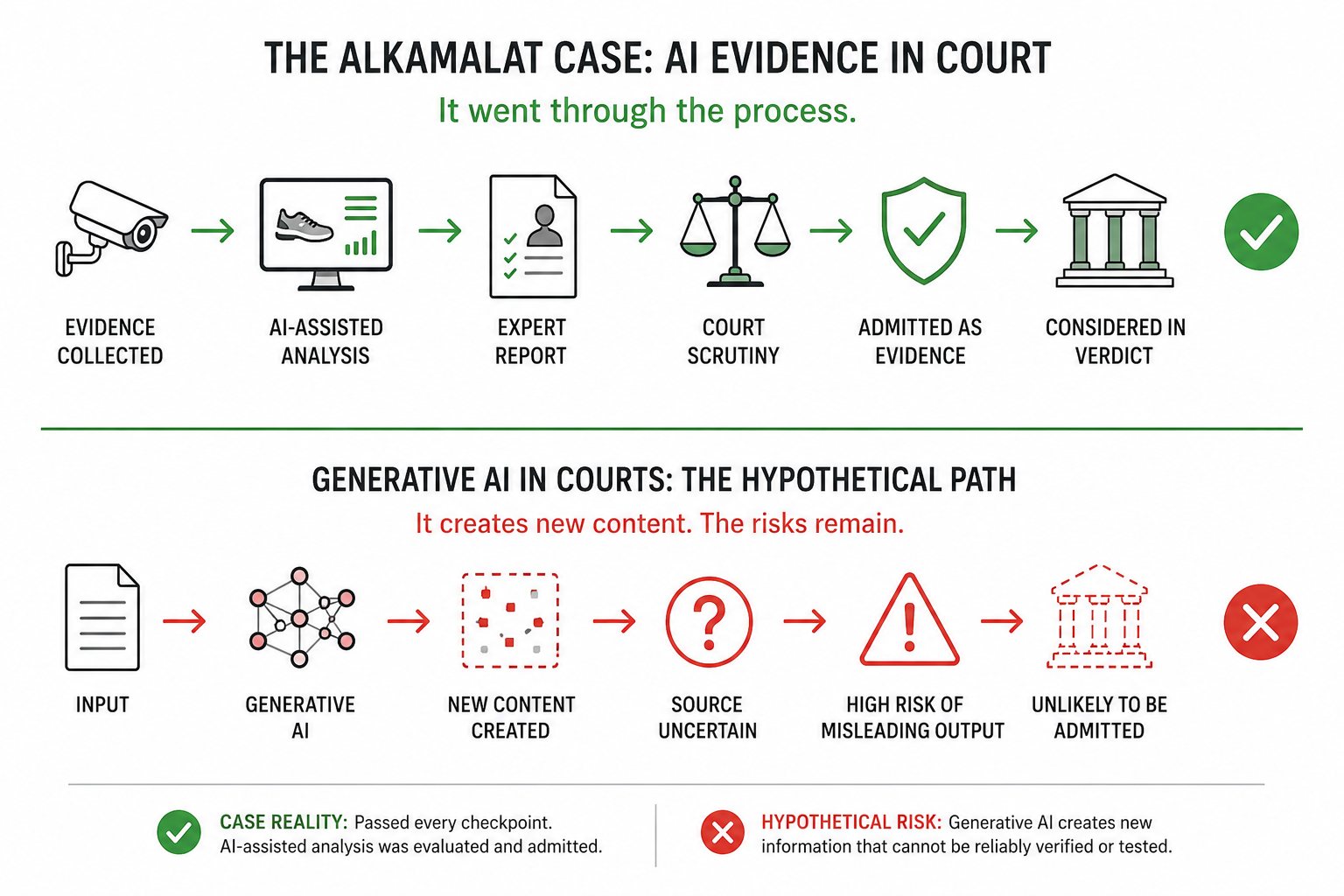
More importantly, it remained there. The AI-assisted analysis was not excluded because artificial intelligence was involved. It was not dismissed as inherently unreliable simply because advanced image enhancement techniques had been used. Instead, it was permitted to proceed through the normal legal process and become part of the evidentiary record surrounding the case. That distinction transformed the discussion from one of possibility to one of precedent. The question was no longer whether AI-assisted forensic analysis could enter the courtroom. The question became how such methodologies should be evaluated once they arrived.
Background and Context
Modern criminal investigations rely heavily on digital imagery. Surveillance cameras, mobile phones, traffic systems, body cameras, and security networks produce enormous volumes of visual evidence that investigators must evaluate.
Yet visual evidence is often far from perfect. Compression artifacts, poor lighting, motion blur, low resolution, environmental interference, and recording limitations routinely obscure important details.
For decades, investigators have relied on various enhancement techniques to better interpret this material. Brightness adjustments, contrast manipulation, sharpening, zooming, frame extraction, stabilization, and other analytical tools have become routine components of digital forensic workflows.
Artificial intelligence represents the next stage in that evolution.
The challenge is that the term “AI enhancement” has become so broad that it often obscures an important distinction. Some systems generate new visual information through statistical inference. Other systems attempt to reveal structure already present within the source material.
From a legal perspective, that distinction matters.
Courts do not evaluate technology based on marketing language. They evaluate methodology. They evaluate reproducibility. They evaluate transparency. Most importantly, they evaluate whether the resulting analysis can be examined, challenged, and understood.
These questions formed the backdrop against which the Alkamalat matter emerged.
Thesis
The significance of Israel v. Alkamalat is not that artificial intelligence decided a criminal case. The significance is that AI-enhanced evidence was allowed to participate in the judicial process without being rejected as inherently inadmissible from investigation to final verdict. This may represent an important early milestone in the gradual acceptance of AI-assisted forensic analysis within Israeli courts.
What Happened
Our involvement in the Alkamalat matter was not centered on determining guilt or innocence. Our role was far narrower.
We were asked to analyze visual evidence associated with a series of robberies and evaluate specific observations derived from the available footage.
Using enhancement and analytical techniques, we examined footwear characteristics, participant movements, and visual details that were difficult to assess within the original material. The analysis produced several observations.
Certain footwear characteristics attributed to the defendant could be excluded as matching footwear visible in portions of the robbery footage. Additional observations identified another individual appearing in the scene prior to one of the incidents whose footwear could not be excluded from comparison. The analysis also raised questions regarding assumptions that all participants were wearing gloves throughout the events.
These observations were documented through an expert report and submitted through the normal legal process. Initially leading to multiple defendant early release, but the court ultimately returned a guilty verdict.
For many observers, that might appear to end the story.
If the defendant was convicted, then perhaps the AI evidence was irrelevant.
These observations were documented through a formal expert report and introduced through the normal legal process. The significance of the Alkamalat matter is not that the evidence controlled the outcome of the case. The significance is that the AI evidence survived the process while adding to the case materially.
The court did not reject the methodology because artificial intelligence was involved. It did not exclude the report because image enhancement techniques were used, nor did it establish a rule that AI-assisted forensic analysis was categorically inadmissible. Instead, the methodology was subjected to the same scrutiny, challenge, and judicial review applied to other forms of expert evidence. The report became part of the evidentiary record and remained available for consideration alongside the other facts and testimony presented in the matter.
That distinction may ultimately prove more important than any individual verdict. Legal systems do not establish standards for emerging technologies through a single dramatic ruling. They establish them through process. The fact that AI-enhanced forensic analysis was able to move through expert disclosure, adversarial review, judicial consideration, and final verdict without being excluded represents a significant development in its own right. Regardless of how much weight the court ultimately assigned to the findings, the methodology was permitted to participate in the judicial process. For future attorneys, experts, and courts considering AI-assisted evidence, that may become one of the most consequential aspects of the case.
The significance of the matter is not that the evidence controlled the outcome.
The significance is that the AI enhanced evidence survived the process.
The court did not reject the methodology because artificial intelligence was involved, nor did it exclude the report because image enhancement techniques were used. The court did not establish a rule that AI-assisted forensic analysis was categorically inadmissible. Instead, the evidence entered the courtroom, was subjected to legal scrutiny, challenged through the normal judicial process, and ultimately remained part of the evidentiary landscape surrounding the case. More importantly, it was accepted into that process and evaluated alongside traditional forms of evidence rather than being dismissed simply because AI was involved.
That distinction may ultimately prove far more significant than any individual verdict. Courtrooms establish the future of forensic technologies not through headlines, but through procedure. Every new evidentiary tool must first demonstrate that it can survive disclosure, challenge, expert review, and judicial consideration. In that respect, Alkamalat may become an important reference point for future matters involving AI-assisted evidence. As the technology continues to evolve, attorneys, experts, investigators, and courts will increasingly look for examples of how artificial intelligence can be introduced responsibly while preserving evidentiary integrity. The significance of the case is not merely that AI entered the courtroom, but that it established a pathway for others to follow.
The Difference Between Generative AI and Fidelity-Driven Reconstruction
One of the reasons the Alkamalat matter is significant is that it highlights an important distinction that is often lost in public discussions about artificial intelligence.
Not all AI enhancement systems operate in the same way.
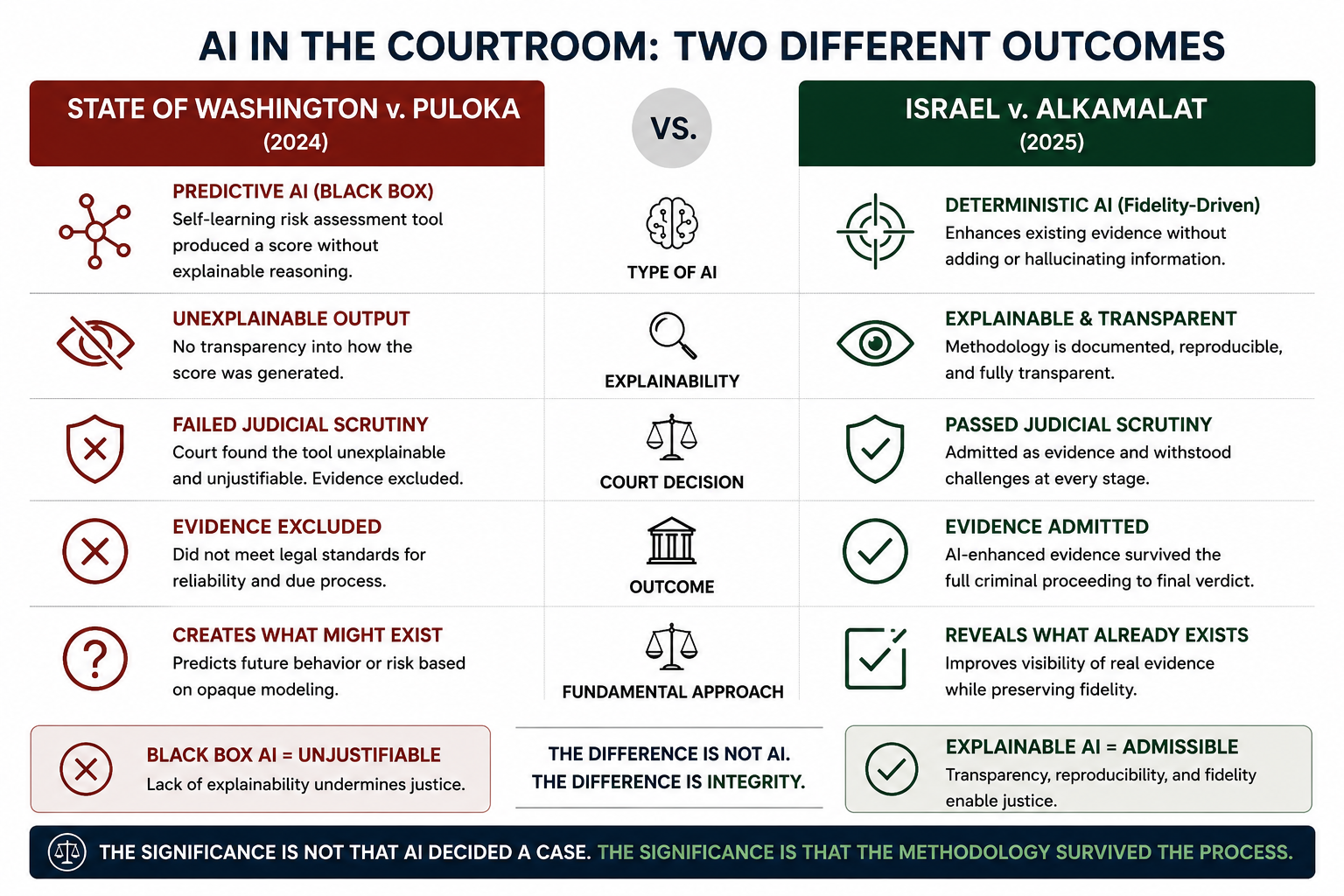
The controversy surrounding AI evidence in recent years has largely centered on generative models. In the landmark State v. Puloka matter, concerns emerged because the enhancement methodology relied on generative artificial intelligence. The system produced visually convincing results, but the underlying problem was not whether the images looked realistic. The problem was whether investigators, attorneys, experts, or the court could determine exactly where the enhanced details came from.
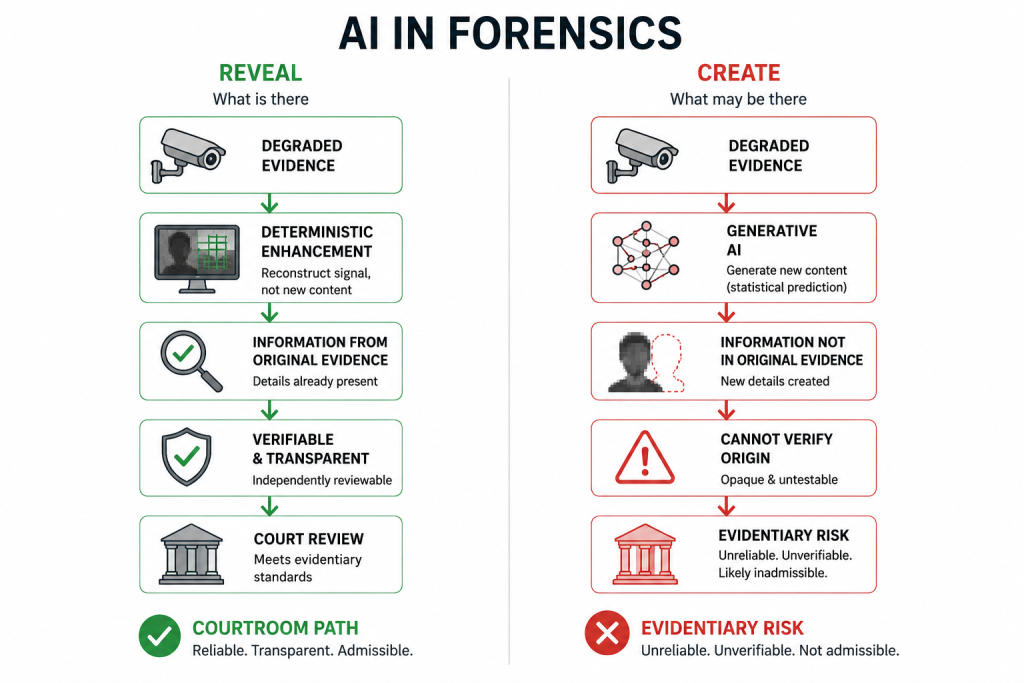
Generative systems are fundamentally predictive. When information is missing, degraded, or ambiguous, the model attempts to infer what should exist based on patterns learned from training data. The resulting image may appear clearer, but portions of that clarity may originate from statistical prediction rather than the evidence itself.
This creates a forensic challenge.
If a critical feature appears after enhancement, can an expert prove that the feature existed within the original evidence? Or has the model introduced a plausible reconstruction based on unrelated examples encountered during training?
In many generative systems, there is no deterministic answer to that question. The internal reasoning process cannot be fully reconstructed, the enhancement pathway cannot be traced pixel-by-pixel back to the source material, and identical inputs may not always produce identical outputs. For forensic environments that demand reproducibility and evidentiary traceability, these limitations become significant.
The methodology used in the Alkamalat matter was fundamentally different.
The systems Predictive Equations uses are largely deterministic and transformative, those systems are designed around fidelity-driven reconstruction rather than generative synthesis. The objective is not to create information. The objective is to reveal information already present within the original signal but obscured by compression artifacts, noise, blur, low resolution, or environmental degradation.
In practical terms, the distinction is straightforward.
A generative system attempts to answer the question:
“What should this image look like?”
A fidelity-driven system attempts to answer the question:
“What can be recovered from the evidence that already exists?”
This difference affects every stage of analysis.
The original footage remains the evidentiary anchor throughout the process. The enhancement pipeline operates as a structured transformation of the source material rather than a synthetic reconstruction of missing content. Independent analysts applying the same methodology to the same evidence can reproduce the same output, examine the same observations, and evaluate the same conclusions.
Importantly, the enhancement itself was not treated as replacement evidence. Rather, it functioned as an analytical aid that allowed the original footage to be re-examined. In the Alkamalat matter, certain observations that had either been overlooked or were not readily apparent during the initial review became significantly easier to identify within the enhanced imagery. Once identified, those same characteristics could then be traced back and verified within the original footage itself. The enhancement therefore did not create the observation. It revealed features already present within the evidence but partially obscured by resolution limitations, compression artifacts, blur, noise, or other forms of degradation.
This distinction is critical. The evidentiary value did not arise because an AI system generated a new image. The value arose because the enhancement process directed investigators and experts toward details embedded within the original recording that could subsequently be reviewed, challenged, and confirmed against the source material. In that sense, the enhancement operated less like a creator of evidence and more like a forensic instrument, increasing the visibility of information that already existed within the evidentiary record.
The resulting enhancement is therefore not treated as replacement evidence. It functions as an analytical instrument for examining the original evidence.
This distinction mirrors the difference between a microscope and an artist’s sketch.
Both may produce a clearer representation of an object.
Only one derives its observations directly from the object being examined, which can then be reviewed objectively mathematically for reproducibility.
That distinction ultimately lies at the heart of why courts are likely to evaluate generative and fidelity-driven systems differently in the years ahead. The legal question is rarely whether artificial intelligence was involved. The legal question is whether the methodology preserves the integrity of the evidence and allows independent verification of the observations derived from it.
For forensic applications, fidelity is not merely a technical preference.
It is the foundation upon which evidentiary reliability depends.
Why This Matters
New forensic technologies rarely enter the courtroom as decisive evidence, and can can take multiple decades.CCTV took approximately 20 years between introduction, to common expected in the criminal prosecution process.
Photography did not.
Fingerprints did not.
DNA analysis did not.
Mobile phone geolocation data did not.
Digital forensics did not.
Each technology followed a similar path.
And initially, these technology appeared as a supporting tool rather than a decisive one. Courts evaluated the methodology. Experts challenged the conclusions. Attorneys questioned the reliability. Judges assessed the relevance.
Only after years of scrutiny did these technologies become routine, and AI-assisted forensic analysis appears to be following the same trajectory.
The first question was never whether AI would solve cases.
The first question was whether courts would permit AI-assisted analysis to participate in cases at all, and for years lawyers faced repercussions for doing so, compared to Israel v. Alkamalat where Predictive Equations enhancement’s being accepted at each stage of the investigation, prosecution and verdict suggests that this transition is already underway.
The Broader Question
Much of the public discussion surrounding artificial intelligence focuses on replacement. Will AI replace lawyers? Will AI replace judges? Will AI replace investigators? These questions make for compelling headlines because they frame AI as a competitor to existing institutions. Yet history suggests that this is rarely how transformative technologies enter professional fields, particularly in law, where adoption tends to be cautious, incremental, and heavily scrutinized.
The legal system does not typically replace expertise overnight. Instead, it incorporates new instruments that expand the ability of experts to observe and analyze evidence. A microscope did not replace biologists. DNA sequencing did not replace forensic scientists. Digital evidence did not replace investigators. Each technology increased the range of observations that trained professionals could make, allowing them to identify details that might otherwise remain hidden while still requiring human interpretation and judgment.
The same principle applies to AI-assisted forensic analysis. In matters such as Alkamalat, the court was not being asked to trust an artificial intelligence system or delegate judgment to a machine. The court was being asked to evaluate expert observations derived from evidence that had been subjected to a documented analytical process. Those are fundamentally different propositions. One transfers decision-making authority to an algorithm. The other uses technology as an analytical instrument to assist human observation. That distinction is critical because it is likely to define how artificial intelligence enters courtrooms in the years ahead.
Conclusion
Israel v. Alkamalat may ultimately be remembered for something much larger than the verdict itself. The case demonstrates that AI-enhanced evidence can be introduced through a complete judicial process, subjected to adversarial scrutiny, evaluated alongside traditional evidence, and remain part of the evidentiary record. That fact alone creates an important reference point for future matters involving artificial intelligence and digital evidence.
This does not mean every AI methodology will be accepted. It does not mean every enhancement process will survive judicial review. Nor does it mean courts have granted artificial intelligence some special status. Quite the opposite. What makes the case significant is that the technology was forced to pass through the same standards applied to every other forensic methodology. The enhancement process, expert conclusions, underlying evidence, and analytical reasoning were all open to challenge and examination and was accepted.
For future attorneys, forensic experts, investigators, and courts, this may become one of the first practical examples of how AI-assisted evidence can be introduced responsibly.
Rather than asking whether artificial intelligence should be allowed in the courtroom at all, future cases may increasingly ask whether a particular methodology preserves evidentiary integrity, maintains transparency, and allows independent verification of its conclusions. In that sense, the importance of Alkamalat extends beyond the parties involved.
It provides an early procedural roadmap for how AI can enter the legal system not as a replacement for evidence or expertise, but as a forensic instrument operating within established legal standards. History shows that every major evidentiary technology eventually reaches a moment where it transitions from theoretical possibility to accepted practice. The quiet significance of Alkamalat is that it may represent one of those moments for AI-assisted forensic analysis in Israel.
Takeaway
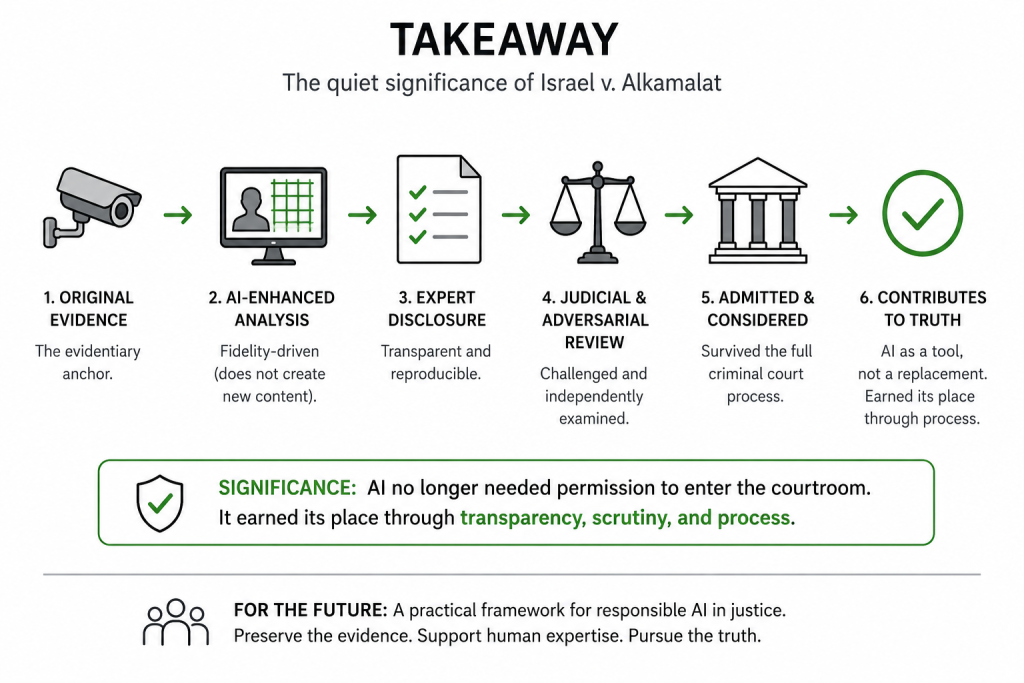
The quiet significance of Israel v. Alkamalat is not that artificial intelligence decided a criminal case. It is that artificial intelligence no longer needed permission to enter the room.
The future of AI in the courtroom will not be determined by the systems that make the boldest claims. It will be determined by the systems that can withstand scrutiny, preserve evidentiary integrity, and contribute meaningfully to the pursuit of truth. Like every forensic technology before it, AI will earn its place not through hype, but through process.
What makes the Alkamalat matter historically significant is that Predictive Equations, known publicly as Predictive AI, successfully introduced AI-enhanced forensic analysis through the full Israeli criminal court process. The methodology survived expert disclosure, judicial review, adversarial scrutiny, and final verdict without being excluded because artificial intelligence was involved. Unlike prior highly publicized attempts that relied on generative reconstruction, the methodology remained anchored to the original evidence and focused on fidelity-driven analysis rather than synthetic content generation.
To our knowledge, this represents the first successful introduction of AI-enhanced evidence through a complete criminal proceeding in Israel. More importantly, it established a practical standard for how artificial intelligence can be used responsibly within the justice system. The original evidence remained the evidentiary anchor. The enhancement process remained transparent and reproducible. The observations remained subject to independent review and challenge. These principles are likely to become increasingly important as future courts confront similar technologies.
For future attorneys, investigators, forensic specialists, and judges, the importance of Israel v. Alkamalat may extend well beyond the facts of the case itself. The matter demonstrates that AI can enter the courtroom without replacing human expertise, without replacing the evidence, and without compromising established evidentiary principles. In doing so, Predictive Equations helped establish an early framework for the responsible use of artificial intelligence in judicial proceedings, one that future practitioners may reference as courts continue defining the standards that will govern AI-assisted evidence for years to come.